One of the most cited experiments in pain psychology dates from 1993. Three groups, one tub of ice water. The first group had to distract themselves during the pain. The second was allowed to simply feel what was happening. The third was told: put the pain out of your mind, don’t feel it.
Those who pushed it away recovered from the pain the slowest. Logical enough, you could have predicted that. But what the researchers found later in the same session is the unnerving part: an innocent vibration on the hand was experienced as clearly more unpleasant by the pushers-away than by the other two groups. Their system had become oversensitive. Not to the original pain. To everything.
Thirty years later, we know why this happens. And it suddenly makes something that was long dismissed as woolly very concrete: pain and emotions that you consistently push away will sooner or later express themselves somewhere else in the body.
Pain and emotion share the same circuit
A second study, at the end of 2025, explained why anxiety itself amplifies pain. The researchers made mice anxious before an operation. Afterwards, those mice had more pain than their calm counterparts, even though they had gone under the same knife.
Under the microscope, it became clear why.
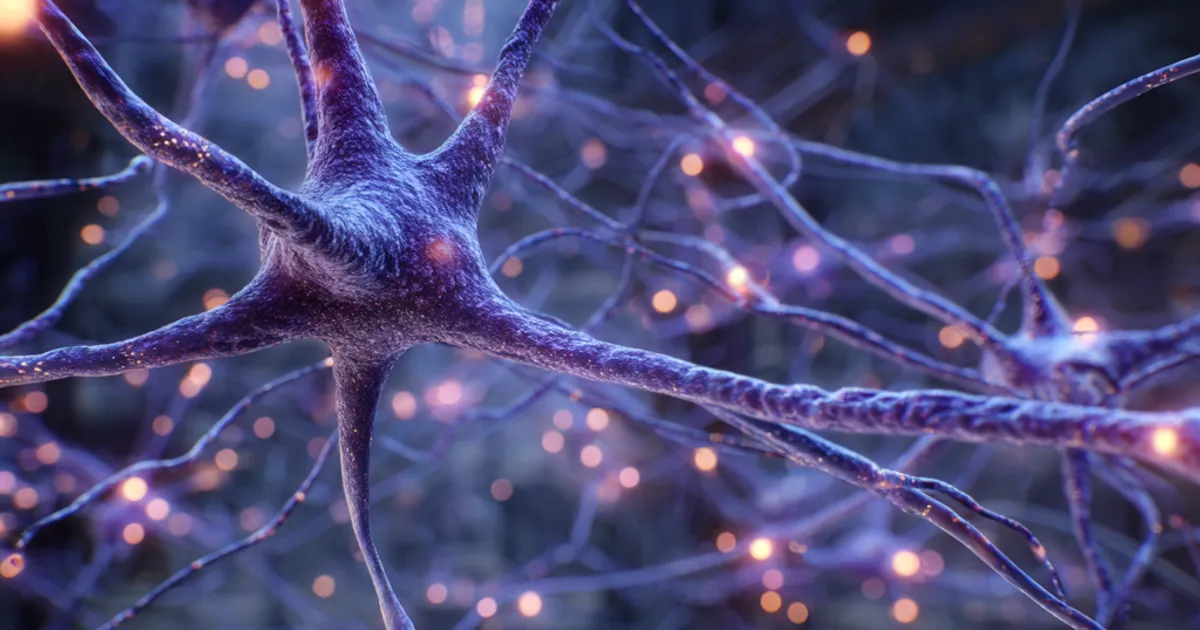
Your brain is home to clean-up cells called microglia. Their normal job is tidying up and pruning. They snip away connections between nerve cells that you no longer use. It is a healthy, everyday process, comparable to a gardener cutting back what has overgrown to make room for what is still growing. It is what allows your brain to learn, forget and adapt.
But under prolonged, unprocessed anxiety, this system goes too far. The microglia go into a kind of overdrive and also snip away connections you still needed. Specifically in the amygdala, the emotion-and-pain centre, the part that helps you see incoming stimuli in proportion gets thinned out. The filter between stimulus and response becomes thinner. This oversensitive tuning of the nervous system has a name: central sensitisation.
You will probably recognise what this means in practice: a light that suddenly stings where it never used to. A sound that hits harder than makes sense. A smell that is suddenly too much. A touch that no longer feels normal. Not because the stimulus has become bigger. Because your system can no longer dampen it properly.
So in that experiment, the pain did not get worse because of the knife, but because the emotion that was present when the pain took place structurally amplified the stimulus.
Pushing through is pushing away too
In the literature on chronic pain, the same strategy keeps coming up as a risk factor: expressive suppression. That is something different from “not feeling the feeling”. It is “feeling the feeling, but holding back its expression”. Smiling while you are falling apart inside. Nodding at bad news. Working through an attack because others are counting on you. Politely answering “I’m fine” on the phone.
In migraine, this pattern is often deeply ingrained, only disguised as strength. Not saying that it hurts. Going to work anyway. Taking a second painkiller to get through the meeting. Carrying on as if nothing is wrong, and telling yourself it will pass.
It is a strategy that was needed somewhere, at some point. But it is exactly the same strategy that slowly puts your central nervous system on a higher alert setting.
What does work can be learned
The same literature that flags expressive suppression as a risk factor consistently points to one strategy as protective: cognitive reappraisal. Not “pretend it’s OK”, but “look at what is really happening here and what it is asking of you”. People who practise this report less fixation on pain, less inflammatory coupling and fewer post-traumatic symptoms.
There is also growing support for mindfulness and acceptance-based therapy, on one condition: that new mindfulness skills are not used to focus away from the pain. That is the difference between being present and avoiding.
What this means for migraine
Migraine is not a psychological condition. The predisposition is partly genetic, and the drivers of migraine are, among other things, metabolic, hormonal, immunological and neurological. The way you deal with tension does not create migraine. But if your system is already tuned to be sensitive, a lifestyle of constantly holding back feeds the sensitisation that can make attacks more frequent and more intense.
Reflection
Which feeling do you hold back by default? Fatigue? Boundaries? Sadness? Anger? The longing not to do something?
What do you do with it? And what would happen if, just once, you simply let it show?
Frequently asked questions
Does suppressing emotions affect migraine?
Migraine is not a psychological condition, but research in people with chronic pain shows that holding back emotions for long periods (called “expressive suppression” in the literature) contributes to sensitisation of the nervous system. In people who already have a sensitive predisposition, this can make attacks more frequent and more intense.
What is central sensitisation in migraine?
Central sensitisation is a phenomenon in which the nervous system becomes oversensitive to stimuli that would normally not bother you: a light that stings, a sound that cuts, a touch that hurts. In chronic migraine, central sensitisation plays an important role in how attacks develop and why they are so persistent. Read more about the sensitisation behind migraine.
What works better than pushing emotions away?
Science consistently points to one strategy as protective: cognitive reappraisal. Not pretending it’s OK, but looking at what is really going on and what it is asking of you.
Where can I start tackling my migraine?
The Building Block Analysis helps you map out which factors play a role in your case, so you can get to work in a targeted way.